Sunday, 14 October 2012

Bones in the Vineyard


Their bitter skins stretch tight over their sweet, seedy hearts. They are Jerez grapes, they hang in great bunches from the last lines of vines atop Segundino´s vineyard.

Yesterday a great mob of Segundino´s kin gathered from far and wide. They came to snip and trim and load and ladle grapes off the vine and into tubs, off the tubs and into the tractor-bed, off the hillside and down into town and up to the open door of the winepress, then trundled into the newly-tiled vat in the funky dark where wine is born.

I told you before about this family, how only two of the brothers  live here full-time, but how their nine brothers and sisters, their spouses and offspring, in-laws and cousins, schedule their lives around the rural rites of vine-cutting, pig-butchering, tree-cutting, bodega-building.  

And when I rolled up on my bike at the vineyard on Friday, they said Sure I could help them with the Vendimia. They needed all the help they could get! And so I was paired with Alberto, Angeles´ 30-something firstborn, an amateur archaeologist who lives in Pamplona. Our hands were busy with the snipping and tucking, and we moved fast along the vines as we talked -- or he talked, mostly. I tried my best to keep up. We talked about Moratinos, local history and culture, what´s been lost since he was a boy here in town, what´s changed for the better. We talked about the Camino -- he walked it in the 1980s, and again not so long ago.

Now and then someone burst into song.

We talked about bones. When he was a boy, Alberto and some other kids found human bones sticking out of the ground right there on the Camino, where the bank had washed out. They loaded them into a big trash bag and took them home. Maybe it was then he decided to study archaeology, he mused.

I asked about those bones. How old might they have been? Could there be a civil war fossa here, a roadside ditch where civilian victims were buried?

No one from Moratinos went missing during the Civil War, he said.  And these bones were clean. Old. The bones found around here go too far back for anyone to remember...Skulls have turned up in the Rio Templarios for time out of mind. Plows uncover tibias and jawbones. People have lived and died here for a thousand years or more, and the clay soil is preservative. When you die it takes a long time to turn to dust.

I told him about Americans´ sense of history, how a building only 200 years old is jealously preserved, considered a landmark -- unless it gets in the way of a parking lot project. Nothing is very old in America. We come from so many places, and the land is so big and wide, we don´t share a lot of common culture. We are individualists. So we honor our family roots. Children compare their ethnic pedigrees: "I´m Russian on my dad´s side, and Scottish on my mom´s." The more mix you had, but more colorful you were... and how chichi it was to have a forebear who was "full-blooded Cherokee!"


He smiled at that. "All of us here?" he said, waving his clippers at Judit and Angel, Sara and Hilario, "every one of us is full-blooded Moratinos. Castilian. Nada mas."

"Purebreds," I said.

We clipped and snipped. He held up a long branch so I could pull the bunches of fruit from underneath.

"The bones you found," I said. "That person might have been one of your ancestors. What happened to the bones? Did you take them to the cemetery to bury?"

Alberto just shrugged. "Why? No one knows anything about whose bones they were. They are bones. They aren´t a person any more."

I gnawed on that for a while. We are sentimental, us Americans and English -- squeamish, morbid, maybe a little paranoid. If my kid found a cranium, I´d scream first, then call the police.  

But old bones, along a path in central Spain... whose innards ended up in Alberto´s trash bag? Were they male or female, Arab, Christian, Jewish, or even Celt?  There´s a paleolithic burial mound a half-mile from the vineyard. There´s a Roman villa nine kilometers east, and a big medieval monastic complex nine kilometers west. Soldiers criss-crossed this countryside, Templar knights, Al-Mansour´s Moorish raiders, French and English fighting over the peninsula. And centuries of farmers, pilgrims, and ordinary Marias and Josés lived here. Their bones had to go someplace when they were finished using them.


I looked at the gravelly soil underfoot, and wondered if anybody was under there, pushing up the grapevines. I laughed at myself, marveled at how centered we humans are on humans -- any bones beneath me could just as well have belong to deer or pigs, dogs or quail, owls or hares or Permian fish, fossilized.

We start as dust, we end as dust. Or bones. We are only us for such a little while.

Smart people make wine while they can. With their families. 


Tuesday, 2 October 2012

My Own Mountain

On Sunday I went back to Liebana, to the great Picos de Europa National Biosphere Park where the Camino Vadiniense begins. I thought I went there to revisit the Camino Vadiniense Guide, a document I wrote a year ago that would enable English-speaking pilgrims to better tackle that tough trail.

But really I did not go up there for pilgrims, or guidebooks, or caminos. I went there for Me.

The first day´s walk got off to a late start. It began at Liebana, the 8th century mountaintop monastery, and continued at an angry stomp up a busy two-lane asphalt road that was not on the maps. I cursed the Vadiniense Amigos group that publicized and mapped and posted this "re-routed" Ruta Vad without, apparently, bothering to waymark the actual trail. After all that peevishness, I tucked myself into a lumpy hostal bed in Espinama, and let myself sleep with the window open to the nippy night air.

I woke to blue skies and birdsong, and started walking from Pido, a cheese-making village, up an unmarked trail to meet the high-altitude Vadiniense I walked last year. It is a medieval cart-track, full of switchbacks and holm oaks, grasshoppers and wide mountain meadows. Fred climbed up part of the way, til a bad ankle turned him back. I soldiered on, up and up. Gray mountain-tops glowered over me. A troupe of nine eagles circled. (They were not sent by The Great Spirit. No. They were waiting to see if I was fixing to die.)

Alone up there in the wide, bright air, it was not hard to forgive the Amigos. I wrote-off the Vadiniense Guide update as a project for someone else. I realized that stretch of mountain, that remote path, is one of my favorite places in the world. If I publish a guide, people will read it and try walking it. They will carry up the soft goat-milk cheese from Pido, they will snap photos and post them on the web, so even more people will climb up to see it -- or they will come in Jeeps, or on odious, fume-belching dirt-bikes or quads. Soon their Coke cans and cigarette butts will appear along the trail, and signs and waymarks and graffiti inviting more of the same. My pristine mountain will be spoiled by riff-raff. And it would be my fault, for inviting them there, for giving them directions.

So maybe it is a good thing the trail markers are bad, I decided. You have to be determined to do this hike. And determined hikers are not the same knuckleheads who leave a trail of NatureFood InstantNRG wrappers in their wake. I thought about trail guides, and pilgrim hostels, and pilgrims, and pilgrimages. I groused about the whiny middle-class tourists we´ve hosted recently, narcissists who have all the gear and credentials, but not a single clue about what a pilgrim is.

I started to say prayers, something I love to do when I am walking. I prayed for my friends, my family, my in-laws, for the Peaceable and Moratinos. I prayed that this person would find kindness in his heart, that that one would learn to believe in herself, that the other one will overcome her fears and make a better life for herself.

"I guess I ought to pray for myself, too," I said. And an answer answered: "You already are. Your prayers are all about You."

And so I reviewed.

Whilst exulting over this beautiful place, I had declared it all my personal property. This was MY wide, bright air. Those were MY eagles and hawks and crows, circling above a whiny narcissist, a tourist praying for HER friends, family, in-laws, house and village. Praying for herself, her needs, her her her, telling God who needs to be fixed, and how to fix them, is a person who needs fixing, who needs to find kindness in her heart, who needs to overcome her fears, to believe in herself.

A woman walking up 1,700 meters with all the right gear and credentials, and not a single clue. Apparently I have to climb up pretty high to be brought low. I apologized.

At the top of the pass I turned the whole way around and looked over the shoulders of the Picos, horizon to horizon. Mountain after mountain, above the eagles, the sky unspeakably vast.

And me, me me. Unspeakably small. I shut up for a while.

The cold wind blew over the ridge, just like it does every day, with me, and without me.    
  

Tuesday, 18 September 2012

Shifting Down

Outside it´s trying its best to rain. I think the sky has forgotten how.
We have not seen real rain here for weeks. We water the vegetables, we water the flowers, we water the fruit trees, each in its turn, after the chickens and dogs and cats get theirs.
One of the black hens died.
Tim´s foot is much improved, but he is still lazy as hell.
The fields are baked brown, the weeds are crunchy alongside the roads. The farmers spread manure this time of year, a job that lays stink over the town like fetid towel. Their plows turn the dung over into the soil. Their tractors carry great rooster-tails of dust behind them, and when they disappear behind a knoll it looks like something´s on fire out there.
The tall trees are turning yellow and flinging leaves down on the breeze.
There´s a breeze. It is cool in the evening, chilly in the morning. Evenings come earlier now, dawn comes later, and night is inky black. The Milky Way spans the sky from horizon to horizon, and galaxies invisible on moonlit nights suddenly shimmer into sight.   
The church is back to being closed all day, even though the pilgrim numbers have not dropped much – they keep coming through in great waves. Some evenings they fill up Bruno´s albergue, and the scent of pasta Carbonara floats down Calle Ontanon. It´s a vast improvement on manure!
The swallows will go soon, if they aren´t already gone. They slip away so quietly.
The windows are still open, the blinds are down to keep out the flies. Sounds roll up from the town and bounce off the front of our house. We hear the radio over at Pilar´s garden, tuned to old men arguing politics. The voices keep the birds out of the fruit trees and grape vines. The vines are loaded, grapes glisten from the stems down along the ground – that´s how the table-grapes are grown here, low down where the leaves shade the soil and hold the moisture. We don´t have a vineyard. Everyone else in town does.
This afternoon, Fran came to the door with a shopping-bag full of table grapes – the second in two week´s time.
This evening, Milagros came to the door with a cardboard box full of table grapes and green figs.
And so we will make Ajo Blanco, one of the great delights of Arab-Andalusian cuisine. It is weird, delicious, mouthwatering food, utterly seasonal. You eat it cold, for Indian Summer. With fresh-cut table grapes like these, it is fit for a king. But try it in January, with hot-house fruit, and it´s almost inedible. Ajo Blanco is not local food. I made some last week, and shared it with Paco and Julia. They had never tasted it. I am not sure they liked it, but Fran did.

You should try it. Here is the recipe I use.

AJO BLANCO de ALMENDRAS (“White Gazpacho”)
Serves 6

1/3 cup blanched almonds
1/3 cup pine nuts (just almonds works fine when piñones are too costly)
2 cloves peeled garlic
1 teaspoon salt
4 handfuls seedless green grapes OR
4 one-inch cubes honeydew melon (I am allergic, but it sure looks good!)
3 slices good quality bread, de-crusted
6 Tablespoons good olive oil
1 Tablespoon + 1 teaspoon sherry vinegar
2 Tablespoons white wine vinegar
4 cups ice water
Another handful of grapes OR melon balls, for garnish

Grind together the almonds, pine nuts, garlic and salt to a powder. Add and puree grapes or melon. Soak bread in water, squeeze it out, add the goo to the processor piece by piece. Slowly drizzle in the oil and vinegars. Gradually add water. Adjust flavors of salt/vinegar.

Chill well. Taste again before putting into individual bowls or cups and garnishing with grapes or melon. Serve cold.


Forgive me if I wrote up this recipe on the blog in the past. I have given it to many friends, and I cannot always keep track of where and to whom I sent it.
Pilgrims love this stuff, this and gazpacho and vichysoisse (leek soup). Patrick and I make them by the ton, especially when the garden is in full swing. We used to burn through it all fast, but now we do not have pilgrims to feed. Just the occasional guitarist, or Couch Surfer, or someone who stayed here before. (Occasionally the chickens end up eating the leftovers. They love soup, but I hate feeling like I am wasting good food.)

We are shifting roles. I no longer call myself a hospitalera, and I am stepping away from teaching others how to become volunteer hosts. Strangers will always be welcome here, but people who can afford it ought to patronize Bruno or Martina´s businesses – I sometimes feel I am taking food from their mouths when I have a full house and they have nobody.

I miss the hippies, though. And the missionaries. The nuns and the scruffy old tramps, the fresh-faced schoolboys and the lost souls.
But I know that winter is coming, and Bruno and Martina will close up and go back to Germany and Italy for a couple of months. We will once again be the Only Place in Town.
And then we´ll get our pilgs. The hard-core Winter walkers, the True Believers, the cold and frozen lunatics from off the path.

Heavens! I never thought I would look forward to winter!


Wednesday, 12 September 2012

Devil Seed

miles and miles of espigas

Nature is cruel. Beautiful as the world might be, it is fraught with bad design. Factor in "the Law of Unintended Outcomes," and your best dog ends up with Devil Seeds lodged in his joints.

Yes, Tim had his right rear paw opened up yesterday at the university veterinary hospital in Leon. (they soon will name a building after us, we´ve endowed them so generously.) He is now at home, recovering slowly and grumpily (crankily? crabbily?) (enough parentheticals already!)

His journey began back in July, after the oats and rye were cut.
When oats and rye are cut, the seed-heads fly, along with several tons of dust, up into the sky and back to earth, where the wind drifts them along the fields and roads like dry, golden snowflakes.

These grains being seeds, they do what they can to travel far, so they can populate new fields and make more rye and oats. They are engineered for hitch-hiking, their husks studded with needle-sharp tips and pointy, backward-facing barbs. They are tiny fish-hooks. They are Devil Seeds. They get into the laces of your boots and they itch like crazy til you pick them out, one by one, from where they´ve worked themselves into the fiber of your shoe-collar or sock or pants-cuff.

Rye espiga, up close. Yow.

Unless you are a dog. In which case, the Devil Seeds will lodge in the spaces between your toes and foot-pads. And if you are a Brittany dog like Tim, your toes and pant-legs have decorative tufts growing on them, beautiful sweeping soft fur that rye seeds find irresistible. Every year we pull espigas from our dogs´ ears and from between their toes. When Bella showed up in July, we thought she was blind in one eye. She would have been soon, but just in time the veterinarian pulled two devil seeds out of her cornea.

Tim, being a fastidious and dignified dog, fusses over his tufts as a matter of course. We did the usual espiga-checks, but didn´t worry too much about him til his toes swelled up. We clipped the tufts, put some Betadine on the swellings, and eventually took him to the vet when things did not improve.

Three times we took him, and each time was more horrific. The vet made an opening between Tim´s toes and went in after the espiga with a medieval-looking tool. He took out some bits. He made Tim scream. He worked with no anesthesia, and we were expected to hold down the dog while he worked.

Tim was not the only creature in need of anesthesia. 

I interrupt this blog for a moment of Divine Providence: Last week some Dutch pilgrims discovered the peanut butter stash and wiped out our last scrap. I asked Santi to send some more, so I won´t have to go back to America while an election is on. And just now, an hospitalero from California on his way to serve two weeks at Foncebadon stopped here for a coffee. He brought along what? Jif Extra Crunchy. He gave me an entire jar. There is a God, and He brings His beloved peanut butter.

Back to dog feet. Despite the vet´s enthusiastic work, the rogue espiga traveled around Tim´s foot-bones and ulcerated itself behind his ankle. His leg swelled up like a balloon. Poor Tim still did not limp, but his energy level dipped. He took to lying beneath the apple tree out back, where everyone but Momo left him in peace. The infection was confined to his foot, but he was clearly unwell.

The veterinarian went on holiday. The university veterinary hospital in Leon went on holiday. There was nothing to do but feed the dog more antibiotics, and wait. So I went on holiday too -- to my annual five-day sand-and-surf break in the Portuguese Algarve. (That´s when the marauders got the peanut butter.)

When all of us got home, Tim was taken off to Leon for contrast X-rays. The espiga showed up right away, just above the open wound behind his ankle -- it was heading north. The doctor took it out, bound shut the incision, jacked him full of pain-killers and sent him home. Today Tim takes his ease in his bed. He snores. We are confident this is the end of his espiga odyssey. Please, God.

Tim in his favorite place in the world

It makes me wonder, though, about design. These seeds are so good at boring into live creatures, evidently an ability developed over millions of years of survival. How does that serve the plant? It´s not like it can sprout inside a dog´s ham, or between its toes, or in the tops of my socks. (althought it is kinda fun to envision Tim with tall stalks of rye growing from his folds, I do not think he would enjoy  that so much.) Does an espiga in a field of dirt bore into the soil the same way it bores into muscle and skin?

And just why do Brittany dogs, bred for hunting and running in fields, have toes and ears so susceptible to this ever-present threat? Whose idea were those fancy toe-tufts and curly fringes?  Our other dogs, with their short coats and bare toes, only rarely pick up Devil Seeds, and they are easily seen and dealt-with. 

I would continue to conjecture, but that might be boring. And it is time for lunch. Paddy made vichysoisse. It will go perfectly with peanut butter crackers. 

Monday, 20 August 2012

Lo mejor de todos


Paco and Edu and an out-of-town guy

Here it is, just after midnight Fiesta Sunday, and we´ve just wound up the Big Feed. It is dozens of people, most of them related to one another, scattered over and around the Plaza Mayor, wolfing down fire-roasted pancetta (pork belly, sorta like unsmoked bacon) and chorizo sausages, melon slices, chunks of fresh bread, Santiago tart, pizza from Bruno´s oven, and raw new wine, served up under the plane trees, under the stars. It was crispy and hot and delicious, the best Big Feed of all the Big Feeds I´ve eaten since I started coming to Moratinos Fiestas back in August 2006.

Panceta experts work in the dark!

There was much to set this fiesta apart from the rest. This time we had two nights of music, and Friday things kicked off with a live rock band. Sure, it was a local garage band, the ten musicians shared six instruments among themselves. It was fine! They were nice boys! And after them came the mobile disco, which blasted Top-40 dance music til 3 a.m. We have a streak of Basque in our population, so the temporary bar on the church porch served xizpazos and kalimoxos as well as shandy and beer and Cuba Libres. We partied down. That was the warmup.

On Saturday at 11:15 the church bells rang to summon everyone to the Patronal Mass. ALL the bells rang -- bells we have not heard for years, as the stairs in the church tower had become too wood-wormy to safely climb, and only one bell has a rope that reaches the ground. This was a cause for consternation, as funerals cannot be properly announced  without someone risking the climb up to the belfry -- you need at least two different bells to ring out the age and gender of the deceased. It was only a matter of time before somebody missed his final send-off. 

We had a community meeting about what could be done, how to do it, and how to pay for it. I told about prefab steel spiral stairs with reinforced steel grid floors (worm-proof) at the top, to stabilize both the tower and the stairway. We´d seen similar  in re-done church towers in Zamora and Medina de Rioseco. I was told that could not work, it would be too heavy and bulky. (what the hell would I know about these things?) Anyway, early this summer the money was found, and in June the diocese sent in a crew to re-do the bell tower, and voila! We have bells again! Atop a prefab spiral stair, with a grid floor.

Anyway, beneath the clanging bells a wooden Santo Tomas Apostal, the patron of Moratinos, stood on his palanquin surrounded by flowers. A fresh-faced priest from the Passionist order, a relation of our neighbor Pilar, was in town for the fiesta and offered to take over the Mass duties.

I love our parish priest, I deeply appreciate him coming to a village this size each week so we can worship. But this guy was a breath of summer air. He walked among us, and spoke the familiar phrases without looking at any books or notes. He was a little over-the-top, but he meant every word he said. We sang the songs out loud, José and Feliciano unfurled the Moratinos banner, the bells pealed and we marched Santo Tomas around the block. (A  pair of French tourists chose that moment to set up their picnic table right in front of the church. We flowed around them, singing. They stood up and doffed their hats as the apostle passed.)

The Mass was standing-room only, and it was glorious. The town has much to be thankful for this year: the bells restored, the new restaurant, a good harvest, a crop of lovely grandbabies, a baptism and a wedding and no funerals. The world outside may be in crisis, but we were there together, big families of some of us, giving thanks on a sunny afternoon in August. We celebrated  the little wonder that we are. 
This is how we roll

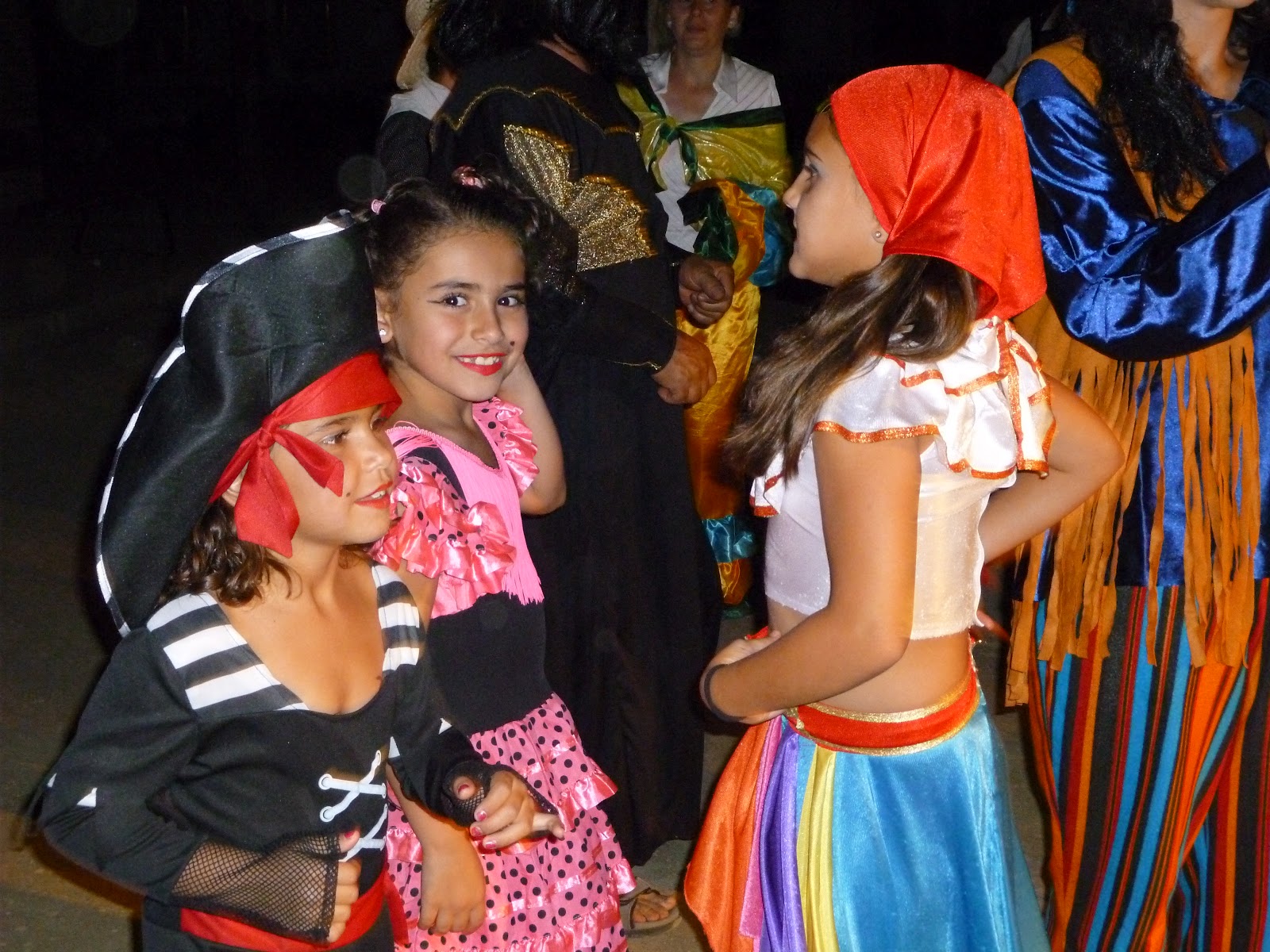
To think I almost skipped the Mass, as we had not started work on our costumes yet! The big Saturday-night dance this year revived a custom dropped some 20 years ago -- a costume contest. We had an enormous cardboard box to work with, and lots of paint to hand. So we made ourselves into a pair of dice. Apparently this is unique here in Moratinos, and when we made our appearance at the 11 p.m. dance, several people busted a gut with jollity (and maybe kalimoxo.)
Campesinas Maria Angeles and Flor

Competition was stiff. We were up against a butterfly, a fairy, a dalmation dog, two each of Red Riding Hoods, hippies, and High Plains Drifters, some remarkably ugly drag queens and clowns, a cave-man wearing nothing under his leopard-skin, Che Guevara, Marie Antoinette, Carmen Miranda, Lord Nelson, and an artistic grouping of campesinos in local ethnic garb. 
dancing babes

Everyone had come as characters. We were the only ones to come as things. Paddy was afraid we might actually win the prize. Until out of the darkness came, on four legs, the most awesome costume of all: a Bale of Straw, complete with a (plastic) pigeon on top. It settled down near the Palentino harvesters, and from inside emerged Leticia and Igor, our sometimes next-door neighbors. Brilliant.

the winning bale

The DJ played awful music at full volume, and we danced into the night. Fran, who often sings old folk songs around town, had his annual star turn with the microphone, singing along to an old paso doble. The customers at the bodega augmented our usual numbers, and vice versa. We shed our cardboard carapaces and danced in circles and lines, with the children leading the way. Children who were toddlers a couple of fiestas ago are now snaking their hips like Shakira. The skinny pre-teens we tutored in English are tending the bar. 
Luis, Christie, and singin´ Fran

We grow up and out and get older, but the fiesta goes on. It´s an annual reunion of people intermarried and tangled together from time out of mind, with new additions here and there and a setting that´s changed little over the decades and centuries.

This is the best fiesta I have attended, the most joyful. Even though some of these people have lost much this year, some are facing ruin as the economy worsens, they are here this weekend, cutting loose with the cousins and in-laws.

I am told the pueblo is still the backbone of Spanish society, that these small-town fiestas draw generations from the cities every summer back to the village to sleep and eat crowded into musty rooms, to dance and feast and worship. Spain will stay strong long as the city-kids are smart enough to now and then  re-connect and recollect what´s old but not obsolete. Long as they don´t forget what is theirs, from centuries ago, that is still so very much alive.


Friday, 17 August 2012

Hot and Heavy


We order a load of firewood each spring, but this year our usual guy couldn´t or wouldn´t do the job -- we never could figure out what his problema was. So we phoned a number posted on the window of the fish shop in Sahagun. "Sure," the guy said, "I´ll be over on Tuesday with a remolque-load."

Miraculously, he arrived just when he said he would. And that remolque-load was beyond miraculous. It was Epic. 

A remolque-load of firewood as we´ve known it lasts us almost exactly one winter. A remolque is a farm trailer, it tows behind a tractor.  Manure, sand, straw bales, and firewood come by the remolque-load. I am not good at estimating volume or weight, but I can tell you a remolque-load of anything takes two people two long days of labor to move and stack (or spread).

But when this remolque rolled up to the back gate, it was towed by a tractor with an 18-wheeler engine. Its sides were twice as high and its bed was another meter longer than the usual remolque size, and it was stacked to the rafters with beautiful logs and sticks of aged, mossy oak.

The man tipped up the pneumatic truck-bed and the remolque-wheels sank into the soft dirt. The timber bonanza roared down the elevated truck-bed and chuckled over itself onto the sand. Logs rolled out onto the N-120, into the back yard, and up against the outer walls, forming eddies and sculptures.  I gazed at them out the double-wide gateway. They blocked out the sun.
twice as deep as it was wide
It cost a small fortune. It had to be moved from outside the walls to inside the orchard before the highway department fined us or a timber-thief decided to help himself. It had to be sorted and stacked five meters away, under the corrugated-steel roof of the wood-store. It  cost us five days of back-breaking labor, during the hottest spell of the summer.

No pilgrims showed up, offering to help out. No friends materialized. So Patrick and I did it ourselves.

We worked together in the early and late hours, when the sun was low. We used two wheelbarrows, and stacked the logs according to size in two sides of the wood-store. A system evolved, a sort of Zen state took over. We wove the logs into continuous sculptures, and slowly filled the little shelter from the floor up to the ceiling with fragrant fuel. It is not elegant, but it fills the space efficiently.

We sweated and swore, we swilled water and beer and lemonade, we ate little and slept deeply. I wore the fingertips out of my deerskin work gloves. We bruised ourselves, we ached. We got it done.

Paddy says he has never worked so hard in his life.

Now at night, when I sit out in the orchard and look up into the Milky Way, the firewood snaps and sighs nearby as it dries in the dark. It is practicing, I think, for winter, for the moment it´s chucked into our little woodstove and crackles into heat and light.

It occurs to me that we bought the wood to warm us. So this summer, without burning even a stick of wood, it´s already given us  our money´s worth.    

Sunday, 12 August 2012

August update

I am not writing, because writing requires a lot of focus, and I don´t have any of that to spare. I think of you blog readers, I make mental notes of cool things that happen and details I see and hear and smell, but I quickly forget them. 

If you look at the header of the blog, you will see what the landscape is like around here. The fields are golden, the grain is cut and baled, and the afternoon sun shines flat, white, hot, and still. Unless the wind blows. Then we get the dust.

Here in August and September, dust rules. It shimmies into the cracks, spreads itself in layers over every surface. There are no truly white sheets or blankets or dogs or cats, nor are there truly white-washed walls. If I look sun-tanned to you, just look close at the crow´s feet wrinkles around my eyes. The skin inside is very white. I, like everybody around here, am wearing a thin coat of golden-brown dust, 24 hours a day.

We have five dogs. With the addition of the gallumphing young mastiff Bella, we have officially moved into "eccentric" territory. Bella is intelligent and sweet-natured, and she has a passion for digging. She has systematically ruined three major efforts at growing greenery in the garden-patches of the new patio. I would not usually be overly upset by this, but for some reason that harsh, sun-blasted, dirt-spattered patio drives me to despair.

Moratinos is thriving. The grain harvest was good, the sunflowers are small but numerous. The Milagros Boys officially opened the Bodega Restaurant Castillo de Moratinos, and it´s attracting people from far and wide. It helps that so many folks are back in the area from Madrid and Burgos and Vittoria -- August is when the families traditionally reunite in their pueblos.

The boys are keeping things simple and local, catering to rural tastes, using local ingredients. So when I offered to translate the menu into English for the pilgrims, I got to know just what those steaming flame-roasted meat nuggets are. They are the thymus glands of suckling lambs, otherwise known as "sweetbreads." The stewed things are are calf-faces and pig snouts. The cold-cuts are very tasty, even if they are thinly sliced cow tongues and pork-bellies!  There are superb chorizo sausages, veal chops, ribs and skewers of chicken breast, all roasted over a wood fire. The Castillo is packin´ em in, and it brings a different feel to Moratinos in general.

Cars are parked all over the place, and strangers stroll the streets. Children have appeared, babies in strollers and long-legged girls on bicycles. The dogs bark at new noises well into the night. People smile and kiss one another´s cheeks, people who have not seen each other for months or years. And when we go into Sahagún, or down to Villada, people there tell us how smart we were to choose Moratinos. Moratinos is the only place around where things are growing, where businesses are opening and a few new jobs have been created. Milagros says it´s the novelty, and the local fiestas. Things will calm down when the weather changes. Farmers-turned-restaurateur have few illusions.   

I miss the Sunday afternoon Vermut in the ayuntamiento. There´s more litter now in the plaza, and grafitti out at the labyrinth. The bar at Bruno´s albergue is suddenly awful lonely, even though Michael has his beautiful girlfriend there with him now. 

We live at a remove from most of it. We live on the edge of town, in the "barrio arriba," the "upper end." Paddy goes downtown for gin-and-tonics and Olympic matches on TV, but I am keeping to myself. I am unsociable, sleeping many hours, neglecting my e-mails and "online marketing opportunities."

And we have been away. We spent a week down in Malaga province with Paddy´s family. Things are not good there -- people and houses are aging, money is tight, predators and leeches abound, and the support systems that once were there are no more. We are not directly related to the problems, so there are limits to what we can do. Paddy worries, but keeps his chin up. I pray a lot, and meditate, and tend the garden and chickens. I make zuchinni bread, and wheat bread, and gazpacho.

Verena, my Zen Master from Austria, showed up a couple of days ago. She says things are hard because things are changing. The whole world is shifting, she says, and I am not the only person feeling it in my bones and my spirit. It is best not to fight it. It is good to take it seriously. It´s a great big wave. I can relax and let it carry me forward, or I can struggle against it, and let it overwhelm me. The key is being still with it, sitting, breathing. Doing nothing.

Doing nothing. Imagine that. In the town where everything is going on!