The annual wood-chopping party took most of Saturday to happen, with most of the male population of Moratinos chopping, lopping, picking up, binding, sweeping, raking, shouting, and backhoe-wrangling. After everyone got cleaned up we reconvened in the Ayuntamiento Bar/classroom/meeting room for La Merienda, "refreshements:" Veal ribeyes, barbecued over the grapevine fire outside, superb Cerrato cheese, and quince jam, and the grapey new wine to try, as well as a lineup of hair-raising moonshine. It was manly food, slabs of hot meat eaten out of hand, cheese carved off the round with a shared knife, wine poured from a re-used plastic liter bottle into beer-logo bar glasses.
I write "we," even though the Plaza Tree-Trimming this year was overwhelmingly male. Right up to the end I was the only woman there. While the men rode backhoe buckets and rickety ladders into the treetops and weilded blades and roaring chainsaws on high, I stuck to the girly-girl tasks of chopping out dead wood with a sickle, pruning the rose-trees, and raking out a foot of fallen leaves in the little flower garden in the middle of the plaza. (The actual growing of flowers is up to more experienced ladies like Milagros and Flor, Leandra and Angeles. Me? I wait til winter. I deal with the dead. We all have our place in the Circle of Life that is our municipal flowerbed.)
The outcome of all this is a shockingly clean Plaza Mayor, where the tortured plane trees look like chickens planted head-down in buckled concrete. In summer they will make a leafy canopy over the plaza, but for now? Well. It is something very stark and Castilian. The other outcome is tons of wood trimmings, split up among the locals for use in their wood-burning furnaces and fireplaces.
This year the lads with the chainsaws also trimmed the decorative trees in our woodlot, a little triangle of unusable land right at the western entrance to Moratinos. The trees belong to the town, but the land belongs to us -- and so the wood on it is ours. (Or so I assume. It could be nobody else wants to bother with scrappy wood way over in el Barrio Arriba, our end of town.) The men helped us drag the biggest, thickest branches up into our back patio, but several trees´ worth of wood still lie on the ground down there. And this is how Patrick and I are occupying our days this week. We are lumber-jacking all that wood into fuel for next winter.
It is hard physical labor. The sun is supposed to shine all this week, however, and Paddy seemed keen to tackle the job.
Paddy wakes up early and walks the dogs a good four miles each morning, no matter the weather. He does his share of cleaning and cooking around the house, he eats healthfully and he gets plenty of sleep. He is not in bad condition, considering all the abuse heaped on his body over his almost-71 years. But this morning, dragging a tree trunk up to our back gate, he looked like a victim of Elder Abuse. He muttered something about an article this weekend in El Pais, the 10 Signs of Heart Attack. He has all of them, he said.
"Stop this then, you daft bastard," I said. "We´ll leave the wood. I bet Fran will be glad to take it. He loves collecting firewood."
"No way am I paying someone to bring us firewood in a truck, while we have all that perfectly good stuff just lying out there for free," Paddy panted. His eyes rolled up into his head.
"So then. You hatchet the twigs and limbs off the trunks and chop it up. There´s a brand-new blade on the chainsaw. I´ll do the hauling," I told him. I hiked down to the woodlot. The two little piles of branches the men left there Saturday had multiplied into the crudely-hacked remains of at least six trees. But I was valiant.
For many hours I lifted and hauled, lurched and swore. I left a trail of twigs behind me as I dragged branches up the steep incline onto the N120, made the sharp right onto the shoulder, and shlepped along the guardrail 100 meters or so to our back gate. Murphy Cat watched, scornful, from the horsetail trees. Fran, the neighbor who collects firewood, came by to offer advice and comfort. Paddy chopped and stacked.
It went on for hours. We still are not finished.
All day we ate leftovers cadged from the fridge, and a loaf of bread made overnight in the bread machine, spread with fabulously fresh peanut butter Philip hauled over in his baggage. We have some Cerrato cheese of our own, and some Cecina de Leon (the world´s finest dried beef). We have a bottle of past-its-due-date Vega Sauco Toro wine, watered-down. The fire dances bright in the stove, and Rostropovich on the stereo, making his cello cry over something Brahms.
The dogs and cat are curled into Cs and Os in their beds, and soon we will sign off on our own consciousnesses in our own comfy places. Wood and good chilly air, hard labor for future comfort, and an early sunset.
The novels are not finished, but the woodpile is growing.
We are not youthful, but we are fine.

Tuesday, 24 January 2012


Wednesday, 18 January 2012
New Bee in Marrakech
 |
| Sundown from the roof terrace: Marrakech |
I am a woman of the world, well-traveled, confident in strange places, and this pushed my boundaries. I have been to public baths before, old Jewish schvitzes, in New York City and Detroit and Baden-Baden. In Madrid I´d taken Philip before to the deluxe faux-Moorish Hammam, great pools of hot and cold water, mint tea in misty rooms, everyone modestly attired in swimsuits, speaking in languages we understood, following a carefully-timed routine.
This was another country. Here in Sidi Bin Slimane, big women whispered to one another in a strange language, trying not to stare at the winter-white carcass old Fatima was handling, over by the entryway -- the carcass was me, a stranger in their weekly ladies-only. There were no limpid pools or hydrotherapy showers or rose-petals. There was concrete, worn smooth by years of water. There were great pipes and faucets, and dozens of plastic buckets. Fatima folded me down to the floor before a lineup of buckets, and poured the tingling hot water from several over my head and shoulders, back and legs.
The old woman worked naked, wet and bulbous and black-skinned. She squeezed oily black soap from a plastic baggie and spread it across a mitt of scratchy cloth, which she rasped across every square inch of my skin. She moved my body and limbs up and aside as if I was a doll, across her lap and much too near to her rolls of skin and hair. Flecks of dark waxy stuff appeared on my surfaces -- I thought the scratchy mitt was shedding lint, or the soap was curdling in the heat. I saw a woman sitting near, peppered the same way, rubbing and rubbing, and I realized the spots were skin, peeled off and rolled-up the same way it did when I was six, in summertime, out on the curb scratching mosquito bites. Fatima was removing my outer layer.
I let myself relax there, face-down on the floor, my body stretched across the old woman´s knees. The only sound was the scrape and scratch of many hands moving, washing skin, exfoliating arms or ankles or the back of the person adjacent. The splash of many gallons striking cement, a groan of shock or release or pain, the feel of those waxy speckles vanishing into the liquid heat. Fatima´s powerful fingers found a knot in my neck. She leaned into it, rolled it under her knuckles, I and felt the ache and the air-miles, the language barrier and a chest-cold flow from my body and roll away across the concrete.
Finished, Fatima patted my knee and smiled the beatific smile of a midwife. I sat sprawled on the concrete for a little while, glowing white in the darkness, feeling myself the newest-born bee in this misty, humming hive beneath the street of the Medina. I am sure I have never been so clean, not since I was first born.
 |
| Phil in our courtyard |
 |
| tourists |
Morocco -- or Marrakech at least -- was delicious and awful. Philip and I stayed at a "Riad," a done-over old courtyard-style house in the old Medina. Riad Dar Zaman is owned by an Englishman with a House-And-Garden decorating style, and the servants, mint tea, babbling fountain, and roof terrace overlooking the neighborhood would usually be outside our price-range but for a very positive currency exchange rate. The city reminded me very much of my three years of childhood in Turkey, what with donkey-carts and caleche carriages, trundling vendors´ carts, a souk and spice markets, dancing monkeys and a spectacular chorus of muzzeins singing live from the city´s many minarets five times every day. The old part of the city is a living museum of architecture, with even the corner shops somehow adorned in plasterwork or tiles or lacquer. Children are treated with great affection. Mosques are well-attended, but you can get usually get a beer with your sandwich if you want one. I bought a splendid wool and over-embroidered carpet for a very fair price. (I brought one of the Riad boys with me to help with the haggling business. Philip now repeats to me, at suitable moments, "Madame! You bargain like a Berber!") (I know, they say that to all the tourists.)
I could not have stayed longer than about four days, however. I was shouted-at by men, until I began walking with a hand on Philip´s elbow. Many women go about fully covered, in veils all the way over the eyes. I kept wondering which of those phantoms might be my hammam-sisters. The tiny streets are overrun with venomously smoky motorbikes, a noise level approaching "jackhammer," and more hustlers and cons and come-ons than a Damon Runyon story.


It is a city, and cities are noisy and polluted. I am a villager. I like my quiet. I was glad to come home.
Philip went home, back to New Hampshire and law school.
Kim came back, and is moving into the little "guitar house" in Carrion de los Condes as the first Artist in Residence of 2012. She is already making movies. She made up a new lot of blog-headers for me!
The first full read of the Zaida novel got a rather glowing review. At least the second half of it did.
Rosie dog has a terrible cut on her behind, we know not from where. Six stitches, and the hood in the photo above to keep her from messing with the wound.
Paddy still has a cold/flu. It is becoming tiresome. He looks done-in.
And so goes the first half of January.
Friday, 6 January 2012
why dogs smile
 |
| walking in the cold sundown |
I am getting things done, however. I applied for a new Residencia card at the Foreigners Office in Palencia, and sailed right through the first part of the process. Kim is coming back. Fred´s been here and left again, and this time we created a non-profit association to administer the artist-in-residence summer program in Carrion de los Condes. I am Founding Vice President, even though I warned them my responsibilities should not go much farther than "Vice."
Philip is still here, too. We are leading a quiet life, walking, reading, writing, shopping, cooking. I fuss about him being bored, but he says I worry too much. He is fine. Next week we are off to Marrakech for a few days, and from there he heads home. I know it is the Way Of the World, but it still makes me sad, thinking of saying goodbye.
 |
| gentlemen of leisure |
Yesterday a box arrived in the mail, from my sister Beth. A few years ago I told my family in America to stop sending me gifts at Christmas, as the expense and trouble were simply too much. But Beth loves gift-giving. Now that she cannot send things to me and Paddy, she instead sends gifts to our animals.
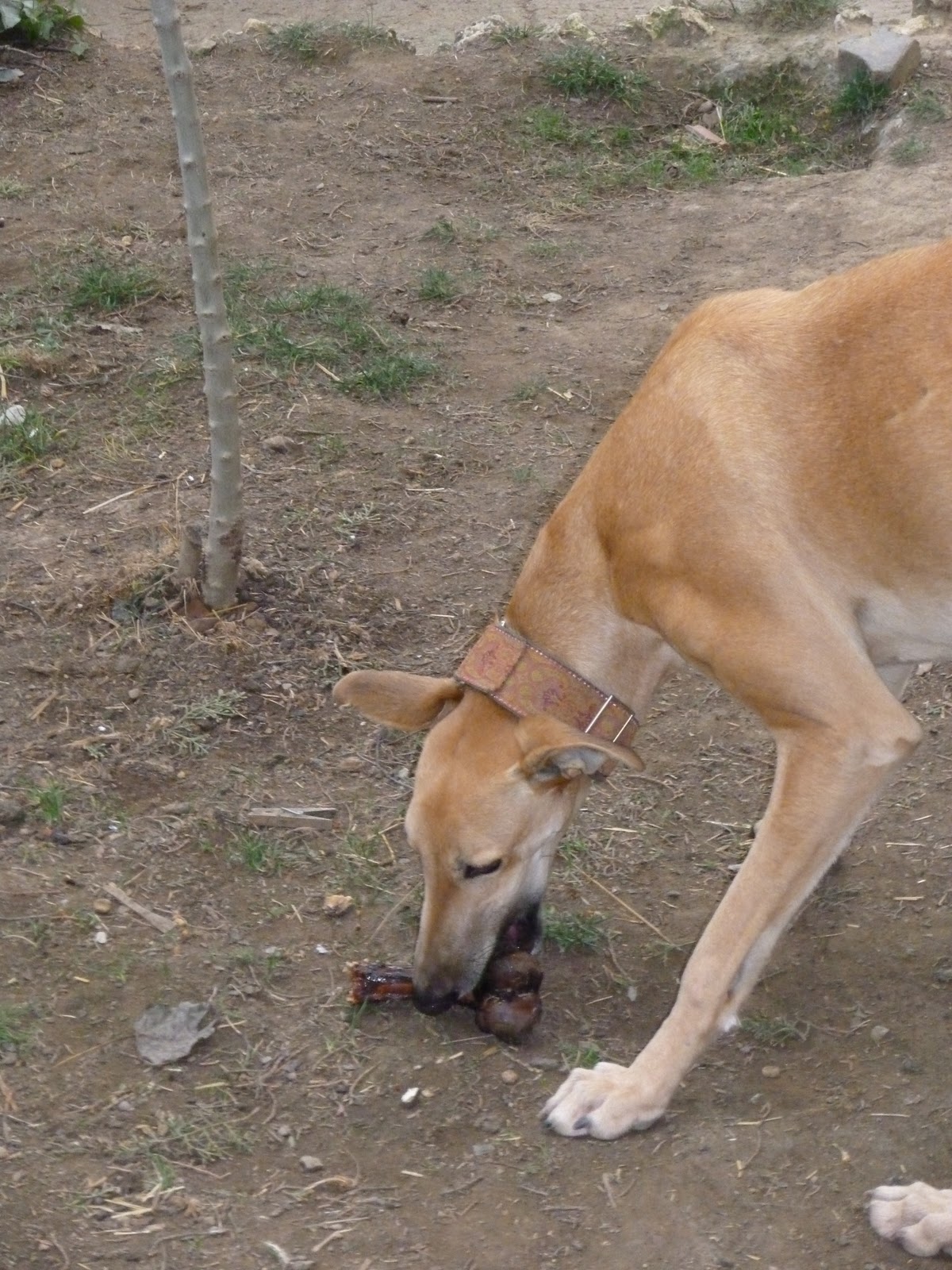
And so we have millet for Bob the Canary, huge Brontosaurus bones for Tim, Lulu, and Harry, a bagful of little rawhide knots for little Rosie, and a squeaky toy mouse for Murph.
At the bottom of the box was a package from my mother: a seat-cushion cover in a Peaceable Kingdom fabric. Where do moms find these things? And Beth, incorrigible, sent me a pad of memo paper in a fancy red leather box. She had to send something!
I took pictures to send to them, of happy critters enjoying their booty. Here they are, you can enjoy them too. Because there´s not so much more than this to tell you about. Not in January!


 sorry, Blogger doesn´t like me messing about with photos...
Saturday, 31 December 2011
A New Year Blessing
 |
| Zamora province, Camino Levante. August 2011 |
For Those Who Have Far to Travel
An Epiphany BlessingIf you could see
the journey whole
you might never
undertake it;
might never dare
the first step
that propels you
from the place
you have known
toward the place
you know not.Call it
one of the mercies
of the road:
that we see it
only by stages
as it opens
before us,
as it comes into
our keeping
step by
single step.There is nothing
for it
but to go
and by our going
take the vows
the pilgrim takes:to be faithful to
the next step;
to rely on more
than the map;
to heed the signposts
of intuition and dream;
to follow the star
that only you
will recognize;to keep an open eye
for the wonders that
attend the path;
to press on
beyond distractions
beyond fatigue
beyond what would
tempt you
from the way.There are vows
that only you
will know;
the secret promises
for your particular path
and the new ones
you will need to make
when the road
is revealed
by turns
you could not
have foreseen.Keep them, break them,
make them again:
each promise becomes
part of the path;
each choice creates
the road
that will take you
to the place
where at last
you will kneelto offer the gift
most needed—
the gift that only you
can give—
before turning to go
home by
another way.Jan L. Richardson, The Painted Prayerbook
This from my friend Claire, who posted it from elsewhere. May 2012 bring us all blessings and revelations.
Wednesday, 28 December 2011
Holy Innocents
 |
| Paddy, Miguel, Martina, and Petra, hospitaleros all |
 | |
| Holy Innocents on Calle Ontanon |
We even got a Christmas tree put up, at the very last minute. It is outdoors, in Murphy´s window, all decked with jolly lights. We let the hens run loose in the yard, and split up a big ol´ cheap sausage among the dogs. A good time was had by all, and seeing as hospitaleros were part of the scene, everything was cleaned-up and put away before sundown.
I picked up Philip the next day, at the airport in Madrid. I will not burden you with the hair-raising ordeal of finding him there. All is well now. He is here with us at The Peaceable, a bigger, broader version of himself. He is my son, whom I have not seen in almost two years! He is a first-year student at Franklin Pierce/University of New Hampshire School of Law. He loves to talk. I am adjusting my sensors from "prevailing silence" to "chatterbox." I love him very much.
Paddy is prevailing silent. Jo, his first wife and mom to his three boys, is hospitalized down in Malaga, gravely ill with blood poisoning. His son Matt is there with her. Paddy is not sure what to do. He is not much good at sick-bed duty, or even keeping his other two sons apprised of events. He cooks us lovely spaghettis and omelettes, and cracks wise, and swears at horse races on the computer. I love him too. I just hope I never get very sick.
The other exciting news on this Day of Holy Innocents is I finally met Alicia! She is the first grandchild born to Julia and Paco, two of our good neighbors. She is a month old, very tiny and pink and doll-like, with very good lungs. Her mother is simply besotted with her, as you might expect. I look at them, and I look at Philip, who was about that size himself only 24 years ago. I marvel at what time does to people. And I rejoice in my heart, knowing Julia has a grandchild, and knowing I never have to face raising another infant of my own!
In the evening Raquel came by, bearing gifts: beautiful yellow apples from their huerta, two jars of jam, and a great quivering block of membrillo -- quince jelly. Milagros gave us a great block of membrillo last week, the same day Angel gave us a spectacular cabbage. We still are discussing what should be done with it. What shall we make with it all? Can it all be eaten?
So here we are with an abundance of food and wine, with friends enough to share our Christmas feast, with family come from far away to spend some time in silence. Here we are with generations of a town: Raquel and Modesto the patriarchs, little Alicia the future. And here we are with worries for one of our own, someone fragile and far, whom we could easily lose.
It is quiet and sunny, chilly and sleepy. The last couple of months have been tough, but 2011 was a very good and busy year for us, taken all together. I can´t ask for any more than that, can I?
Tuesday, 20 December 2011
Short Days. Long hours.
We have been very ill for the past week. Even after a round of anti-biotics I am still unwell. This is getting very tiresome.
Paddy is gone to London to attend a friend´s funeral. I am here, but I am not alone.
Fred wafts in and out, bringing groceries, repairing the front gates and spoiling the dogs. With Paddy gone, the dogs are particularly needy. I take them for long walks in the mornings, probably over-long -- I am worn-out by 11 a.m. They stay near me, they run hard but do not let me out of their sight. I think they might be taking care of me.
This morning, over at the Grand Canyon near San Nicolas, I saw two beautiful foxes slipping over the broken ground and up the camino. Lulu and Harry saw them too, but they didn´t chase them. Maybe they, too, were awed by their fluid beauty.
Christmas is coming to Moratinos. The little plastic Bethlehem is all set up in the church entryway, with real moss and dried flowers for trees. It is silly and beautiful. Each Sunday the Magi are a little farther along the sandy pathway to the manger in the upper corner.
I do not know why, but there are two Baby Jesuses.
Over at the bodegas José and Esteban toil away in the concrete bunker that will sometime soon be a bar and restaurant. Fred stored some box-wine in our bodega, but this weekend discovered mice had chewed through the cardboard, eating the glue all along the edges. They pierced the foil bags inside, of course... and so we have a mess in the cave, and some rodents full of holiday cheer! Tasteful mice. They only chewed the boxes from France.
At Hostal Moratinos, Martina spends her mornings waiting for the scarce pilgrims to pass. She offers them German herbal teas, gingerbread, pumpkin soup. If no one shows up to take a room, she lowers the blinds at sundown and tucks herself away.
The nights are very dark and cold. The stars are hard and sharp in the sky, and Orion spins across the firmament as the hours pass.
At the Hospital San Bruno, the pilgrim albergue, Bruno and Miguel have an electric star in the front window. The place will be closed between Christmas and New Year´s Eve, when it seems everyone will be back in town. We will take up the slack, here at the Peaceable, in the days after Christmas, the very last days of the year.
Pilgrims are already running into trouble: daylight is so short, the distance between open albergues very long. A German man showed up last night just after midnight, banging on the back door, the emergency exit we rarely use. He was lost, exhausted, and very sorry. And lucky -- he chose the right house! I put him in the green bedroom. He ate a banana and three pears, then slept for 13 hours.
I am led to meditate these days. Perhaps because of the long nights, perhaps because there is so little else to do that is interesting. (Reading makes my head swim, and we don´t have a TV.) Meditation makes my senses sharper, makes me slow down and think and appreciate more. Music sounds better, I hear the crows and hawks shouting at one another in the fields. Twenty minutes a day makes a world of difference. It also is an agony for little Rosie, who must leave me alone the entire time!
She watches me, even when she is asleep. She follows me, wherever I go.
I am alone here, but I cannot be lonely.
Paddy is gone to London to attend a friend´s funeral. I am here, but I am not alone.
Fred wafts in and out, bringing groceries, repairing the front gates and spoiling the dogs. With Paddy gone, the dogs are particularly needy. I take them for long walks in the mornings, probably over-long -- I am worn-out by 11 a.m. They stay near me, they run hard but do not let me out of their sight. I think they might be taking care of me.
This morning, over at the Grand Canyon near San Nicolas, I saw two beautiful foxes slipping over the broken ground and up the camino. Lulu and Harry saw them too, but they didn´t chase them. Maybe they, too, were awed by their fluid beauty.
Christmas is coming to Moratinos. The little plastic Bethlehem is all set up in the church entryway, with real moss and dried flowers for trees. It is silly and beautiful. Each Sunday the Magi are a little farther along the sandy pathway to the manger in the upper corner.
I do not know why, but there are two Baby Jesuses.
Over at the bodegas José and Esteban toil away in the concrete bunker that will sometime soon be a bar and restaurant. Fred stored some box-wine in our bodega, but this weekend discovered mice had chewed through the cardboard, eating the glue all along the edges. They pierced the foil bags inside, of course... and so we have a mess in the cave, and some rodents full of holiday cheer! Tasteful mice. They only chewed the boxes from France.
At Hostal Moratinos, Martina spends her mornings waiting for the scarce pilgrims to pass. She offers them German herbal teas, gingerbread, pumpkin soup. If no one shows up to take a room, she lowers the blinds at sundown and tucks herself away.
The nights are very dark and cold. The stars are hard and sharp in the sky, and Orion spins across the firmament as the hours pass.
At the Hospital San Bruno, the pilgrim albergue, Bruno and Miguel have an electric star in the front window. The place will be closed between Christmas and New Year´s Eve, when it seems everyone will be back in town. We will take up the slack, here at the Peaceable, in the days after Christmas, the very last days of the year.
Pilgrims are already running into trouble: daylight is so short, the distance between open albergues very long. A German man showed up last night just after midnight, banging on the back door, the emergency exit we rarely use. He was lost, exhausted, and very sorry. And lucky -- he chose the right house! I put him in the green bedroom. He ate a banana and three pears, then slept for 13 hours.
I am led to meditate these days. Perhaps because of the long nights, perhaps because there is so little else to do that is interesting. (Reading makes my head swim, and we don´t have a TV.) Meditation makes my senses sharper, makes me slow down and think and appreciate more. Music sounds better, I hear the crows and hawks shouting at one another in the fields. Twenty minutes a day makes a world of difference. It also is an agony for little Rosie, who must leave me alone the entire time!
She watches me, even when she is asleep. She follows me, wherever I go.
I am alone here, but I cannot be lonely.
Saturday, 10 December 2011
Signed, Sealed...
Now that the manual work is done, I need to get down to the written test.
Which is another way of saying "Christmas cards." I try to keep track of all the friends and family and just random kind people who touch us in special ways each year, and at the end send them each a nice hand-written holiday card. This should not be difficult, seeing as we no longer clog our Decembers with evergreen trees, holly, or extravaganzas of cookie-baking, partying, or gift-giving. I string a line of Christmas lights around the living room or over one of the larger house plants. I bake stöllen or lebkuchen or something merry, and if we expect a crowd I will roast a fowl or some kind or other. This year I grew parsnips and brussels sprouts in the garden, just for the holidays, because Paddy likes them. (we shall see how they turn out!) But compared to the month-long lunacy so many people undergo, things are pretty simple and easy around here at Christmas. I like to think if a star appeared in the east, or a baby was born out in our barn one of these nights, we might not be too busy to notice.
Anyway, we looked over our diary and thought back over the nice things we enjoyed this year, and we made up a list of people to send cards to. I bought ten nice ones from the UNICEF display at the post office. Ten cards. It tends to focus things a bit. Who is on the list?
>Kathy, who sends us divine Mexican tortillas from California, at vast and foolish expense. Who flies to Spain to walk with me on unexplored trails. A great friend. A card for her, surely.
>And one for Tracy, who drove me and Kathy up to the mountains, and let me stay at her villa in Marbella, and is soon to open a pilgrim welcome place in Galicia.
>Denis, the French Scotsman who rescued Kathy and me from the hot griddle that was the last three kilometers of the Camino Vadiniense in late July. Sent by angels. A card is the least I can do.
>Miguel Angel, my Mexican-French psychoanalyst friend. I did not see him this year, but on a particulary tough day in the spring a courier delivered an elegantly wrapped tin. Inside were waxed papers, embossed with the name of a French pàtisserie: Pastries. Cookies. Sweetness. He was just thinking of us, he wrote on the little slip inside.
>Filipe, my Portuguese DNA scientist and bosom friend who whisks me off to the beach.
>Dael, the dour Scotsman who helped me move 16 tons of dirt onto the bodega roof in May. The man deserves much more than a card. He needs a medal of honour, that one.
>George, from Virginia. An academic, a gentleman, a scholar, a mystic. He introduced me to movie stars in February in Washington D.C. We go way back. I love him.
>Ivar, who lives in Santiago and always welcomes me to town with a big lunch and all the latest camino news.
>John and Stephen, more Scotsmen. They walked and talked with me across the baking plains of Valladolid and Zamora provinces, and who now are innovating a pilgrim welcome center in Santiago. Visionaries.
>Marion, and the other very English people in the Confraternity of St. James office in London, who edit and publish the guides I write. Infinite patience. Hard work. No pay. Except maybe a card now and then. Worker bees.
>Colin and Margaret, from Wales. They drive their camper van from home all the way to Rabanal in the summer, to volunteer at the monastery there. They stop here on the way, and have done ever since we lived in the summer kitchen. They bring us Marmite, cheddar cheese, Branston Pickle, and week-old copies of The Times and The Guardian, and great good cheer.
There are others. You get the idea.
What do all these fine people have in common, except acquaintance with me and The Peaceable?
I cannot find postal addresses for any of them.
In the Information Age, I am without their data. It is here somewhere, maybe tucked into a computer file, or scrawled in a notebook. I have found addresses for Kathy and George, but I know those are out-dated. And Kim. Where is Kim these days? The sangha in Colorado, the Hindu chant-fest in Puerto Rico, or in Key West? I could send out an email appeal to all of them, but that would spoil the little frisson of receiving an honest-to-God, hold-in-your-hand greeting, wouldn´t it?
So here I sit with beautiful little cards and lots of good will, but noplace to send it all.
I wish everyone could be blessed with such a problem. Lucky old me!
Which is another way of saying "Christmas cards." I try to keep track of all the friends and family and just random kind people who touch us in special ways each year, and at the end send them each a nice hand-written holiday card. This should not be difficult, seeing as we no longer clog our Decembers with evergreen trees, holly, or extravaganzas of cookie-baking, partying, or gift-giving. I string a line of Christmas lights around the living room or over one of the larger house plants. I bake stöllen or lebkuchen or something merry, and if we expect a crowd I will roast a fowl or some kind or other. This year I grew parsnips and brussels sprouts in the garden, just for the holidays, because Paddy likes them. (we shall see how they turn out!) But compared to the month-long lunacy so many people undergo, things are pretty simple and easy around here at Christmas. I like to think if a star appeared in the east, or a baby was born out in our barn one of these nights, we might not be too busy to notice.
Anyway, we looked over our diary and thought back over the nice things we enjoyed this year, and we made up a list of people to send cards to. I bought ten nice ones from the UNICEF display at the post office. Ten cards. It tends to focus things a bit. Who is on the list?
>Kathy, who sends us divine Mexican tortillas from California, at vast and foolish expense. Who flies to Spain to walk with me on unexplored trails. A great friend. A card for her, surely.
>And one for Tracy, who drove me and Kathy up to the mountains, and let me stay at her villa in Marbella, and is soon to open a pilgrim welcome place in Galicia.
>Denis, the French Scotsman who rescued Kathy and me from the hot griddle that was the last three kilometers of the Camino Vadiniense in late July. Sent by angels. A card is the least I can do.
>Miguel Angel, my Mexican-French psychoanalyst friend. I did not see him this year, but on a particulary tough day in the spring a courier delivered an elegantly wrapped tin. Inside were waxed papers, embossed with the name of a French pàtisserie: Pastries. Cookies. Sweetness. He was just thinking of us, he wrote on the little slip inside.
>Filipe, my Portuguese DNA scientist and bosom friend who whisks me off to the beach.
>Dael, the dour Scotsman who helped me move 16 tons of dirt onto the bodega roof in May. The man deserves much more than a card. He needs a medal of honour, that one.
>George, from Virginia. An academic, a gentleman, a scholar, a mystic. He introduced me to movie stars in February in Washington D.C. We go way back. I love him.
>Ivar, who lives in Santiago and always welcomes me to town with a big lunch and all the latest camino news.
>John and Stephen, more Scotsmen. They walked and talked with me across the baking plains of Valladolid and Zamora provinces, and who now are innovating a pilgrim welcome center in Santiago. Visionaries.
>Marion, and the other very English people in the Confraternity of St. James office in London, who edit and publish the guides I write. Infinite patience. Hard work. No pay. Except maybe a card now and then. Worker bees.
>Colin and Margaret, from Wales. They drive their camper van from home all the way to Rabanal in the summer, to volunteer at the monastery there. They stop here on the way, and have done ever since we lived in the summer kitchen. They bring us Marmite, cheddar cheese, Branston Pickle, and week-old copies of The Times and The Guardian, and great good cheer.
There are others. You get the idea.
What do all these fine people have in common, except acquaintance with me and The Peaceable?
I cannot find postal addresses for any of them.
In the Information Age, I am without their data. It is here somewhere, maybe tucked into a computer file, or scrawled in a notebook. I have found addresses for Kathy and George, but I know those are out-dated. And Kim. Where is Kim these days? The sangha in Colorado, the Hindu chant-fest in Puerto Rico, or in Key West? I could send out an email appeal to all of them, but that would spoil the little frisson of receiving an honest-to-God, hold-in-your-hand greeting, wouldn´t it?
So here I sit with beautiful little cards and lots of good will, but noplace to send it all.
I wish everyone could be blessed with such a problem. Lucky old me!
Subscribe to:
Posts (Atom)