Friday, 30 September 2011

Hound Dog in the Promised Land


Paddy, Promised Land
If you have been round here for long, you know about the Grand Canyon, Labyrinth, Tumberon, Hare Field, Medieval Lane, and Happy Valley -- names we´ve given to the trackless landscapes around us.  You will not find them on any maps, but these names enable us to find one another while dog-walki, bush-whacking and star-gazing, or better describe to one another where we spotted the owl or the avutarda.

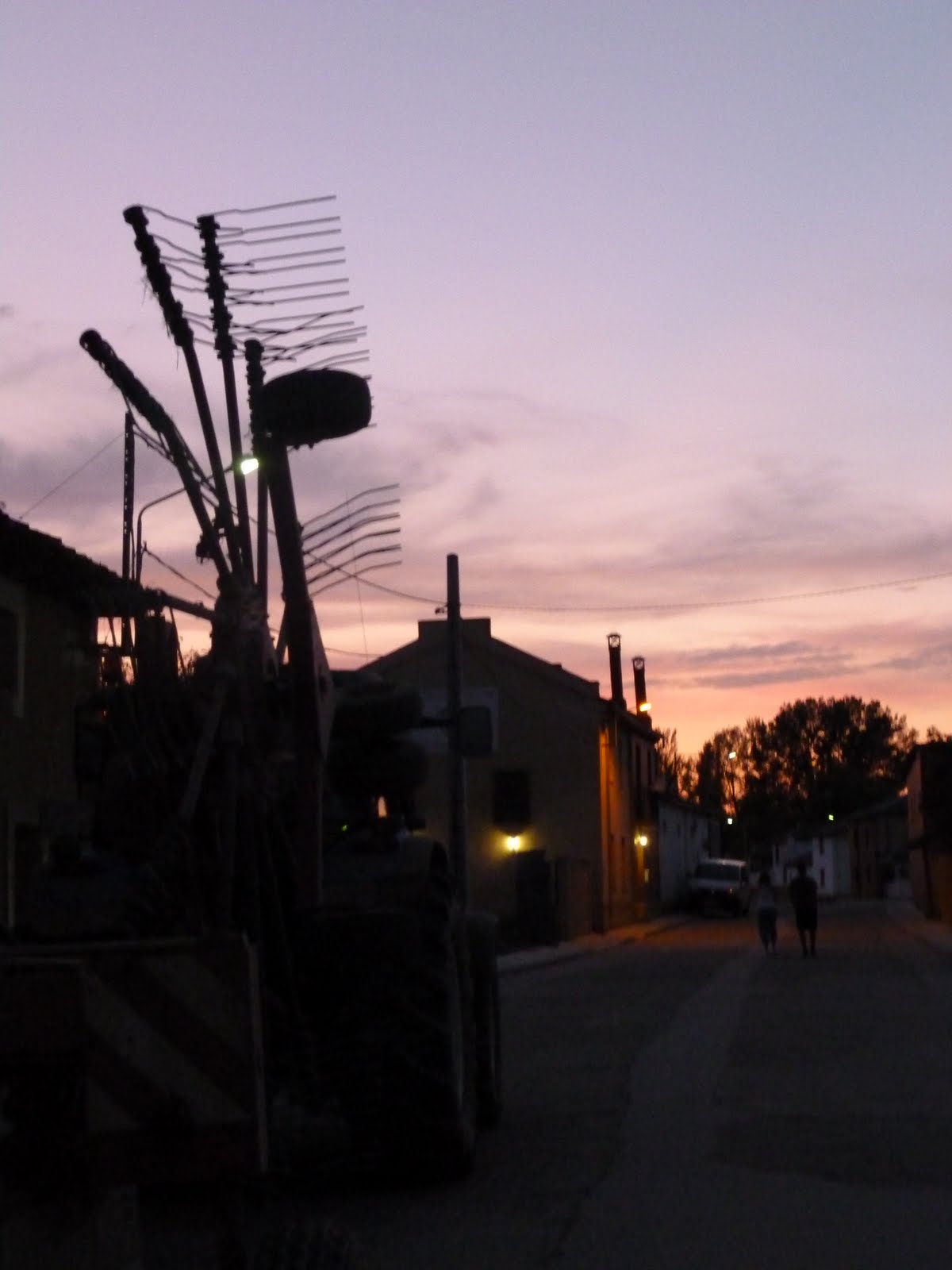
So... what´s the Promised Land look like in September, when the fields are cut and there´s been no rain for many weeks? Here you go. Shot today, while the camera battery stuttered out its last moments of power. I will do better next time, I promise.

soybeans sprouting near the bodega hill

Wednesday, 28 September 2011

Delighted

Things delight, if you let them.
Here are several things that delight me lately.

My grandad Albert Scott celebrated his 94th birthday Saturday. He is sharp and smart and funny, and now he has a girlfriend! Her name is Betty. She is a sweet young thing of 80-something.

This morning I picked a bucketful of sweet yellow apples from the trees in our back yard. I thought to make pies with them, but realized I still have sliced-up apples from last year in the freezer. I pulled those out to use them up, and discovered frozen sliced-up cherries, too. And cascabellas, the little cherry-ball fruit thingies that grow on the tree out front. So in the oven now is an apple pie and a cherry-cascabella pie.

I don´t know who will help us eat them, or even if they will be very good after all this time in the freezer. But we´ve seen a spate of very fine pilgrims lately. Hungry ones. And I bet these pies are going to be fabulous.

Lately the fruit and veg are beyond compare. In the past two weeks I have made the finest Red Gazpacho Andaluz AND the finest Sopa Ajo Blanco of my entire life. And some killer zuchinni bread and veggie quiche as well. It´s the vegetables, people. September is the moment for fresh vegetables and fruit, and I love to eat!

I delight in Literacy. Over the last couple of weeks I re-wrote Zaida, a novel I wrote last year about a Moorish princess who lived nine kilometers away and a thousand years ago in Sahagun. The book is now being read critically by three trusted people. And of course I now am discovering a great trove of historic information on that time and place that will have to be rubbed into the story somehow! I am delighted to say I feel no fear or resistence to re-writing the whole thing again if I have to -- I may need to make Zaida into a tough cookie instead of the innocent hard-done-by. This is a wonderful and simple story, but I am not so attached to my work that I cannot chop out chunks of it to make it even better.

Reading deeply of historic texts has always been a favorite pastime. Now I can do it with an end in sight. It makes me want to go and visit Córdoba and Sevilla (where Zaida grew up). Just about every tourist who comes to Spain goes to see Sevilla and Córdoba, but until now I have managed to miss them both. (FYI: Leprosy did not exist in western Europe until the 12th century, when the crusaders brought it home with them from the Middle East.)

I am delighted that Leena, a friend from England, may be coming in a few weeks to stay with the dogs, so Paddy and I can go together to see the splendid Moorish cities down south. We almost never travel anywhere together, so it is a treat when it happens.

Meantime, the camino has offered up some wonderful characters. We hosted a kilt-wearing Shaman massage therapist, a high-church Episcopal priest from Fort Worth (he updated me on goings-on in my beloved US denomination and did a bit of healing as well); Another night brought a chipper Dutch-English couple who run hotels in Costa Rica. (The man is a jolly prophet of our oncoming collective economic doom). We also had a beautiful Irish girl who explained how hashish is made, using freezer bags and tea strainers and a rolling-pin.

We bought three new tires for the car in a week´s time, and now the front end is making a not-encouraging sound when I turn the wheel hard. So far we´ve been able to address the problems as they rise... including the fused light-switch in the salon. When things go, they all go at once.

The English lessons are swimming along. It delights me to hear Flor and Estevinas saying aloud, “The doves are timid,” “I have no money,” and “José is drunk.” Some of them are doing very well indeed, even though I still do not know what I am doing. The hours of 5:30 to 7 p.m. Saturdays goes by faster than any other hour-and-a-half of the whole week.

Our critters are healthy, we are getting over colds, and we put the last couple of pilgs on a train for Oviedo just before lunchtime. Now I will have a nap.

We are doing delightfully.

Thursday, 15 September 2011

The Year´s Hard Crown

Internet is back. I am taking all the credit, even though I am not sure which of the several "fixes" I tried was the one that worked. It is all very mystical and mysterious. Maybe a saint dunnit. Thank you, whomever or whatever. Living takes on an odd cast when you know the communication links are down.

The sky is full of herds of birds, lots flying south, a few heading north! This afternoon we saw eight gray geese fly across the fields near St. Martin de la Fuente. The sky is becoming silent now. In the morning, out on the Promised Land, nothing can be heard but crows. I saw a snake out there the other day, black and gray, running away.

It is manure-spreading season. The familiar perfume hangs in the air. The flies are bad.

At the bodegas work continues on the new underground restaurant, with a forest of floor-jacks and elaborate cement-injection machines blasting away on the roof. Someday, something awesome is going to be there. Around the other side of the hill the Segundino family is rebuilding a collapsed bodega, connecting it inside with their current cave. Beautiful arches of bricks, all of it going to be buried at the end. We are keeping busy too, taking care of business: furnace maintenance, new front tires on the car ("Fear As Tony," the tire man recommended: Great for farm vehicles. Tough as nails. American. Then I saw the brand printed on the side of the tire: Firestone! Aha!) All we need now is a window and door out back, for Paddy´s painting studio.The next ordeal.

It all would be rather boring and anodyne if I was not working a good four hours each day on Zaida, the novel I wrote last November. I am doing an overhaul, a re-write, smoothing out all the repetitions and stupidness that slips into a document that size. It is productive, it is creative, and it is funner than just about anything else I do. Half my day is spent in Sahagun, but a thousand years ago.

The work is only apropos, seeing as Autumn is on its way.
Next to the downstairs toilet we keep a copy of "The Unquiet Grave," a series of epigrams by that cheery old elf Cyril Connolly. In there this morning I found this:

The creative moment of the writer comes with the autumn. The winter is the time for reading, revision, preparation of the soil; the spring for thawing back to life; the summer is for the open air, for satiating the body with health and action, but from October to Christmas is for the release of mental energy, the hard crown of the year.

Hear, hear, Cyril. I could not agree more! And now that I have the re-write half finished, other projects are flowing in -- Mitch is going to Bolivia at the end of the month, and will be writing madly after that to have his book in shape for a November deadline. I agreed to do that re-write, too -- no doubt chapter by chapter, as the draft is finished. Should be fun. I might actually make some money, too!

And then there´s the Vadiniense guide, and an article or two about the route for a couple of pilgrim magazines. Kim sent me a huge zip file of blog entries and photos... I haven´t had the nerve to open it yet.

It is very good to be booked-up. Things like blogs, housework, friends and birthday cards are neglected, but I don´t feel too guilty. I am doing what I do best, what I love most.

Sunday, 11 September 2011

Limited Contact

The internet connection in our house has gone south again. I write this from Bruno´s place. I will get back into better touch when Civilization returns to The Peaceable.(everything else seems to be breaking down, too. Tis the season!)

Meantime, I am doing the re-write on Zaida, the novel I wrote last November. Without the internet distractions the work is progressing apace. Also, the English lessons here in Moratinos recommenced yesterday evening... I thought I might get five or six takers, now that the summer rush is over. But TWELVE people showed up, and stayed for a full hour and a half! What fun!

But seeing as I need to move on out of here before another purchase is required, here is my offering for the week. An offering, really, from Kim. She lived with us for a good while in the last couple of years. She is a  gifted woman, and a filmmaker. Here is her summary of her Year On The Road, part of which was spent with us in Moratinos. I could never have put it better than she does -- our house, and the Camino de Santiago, and Finisterre at the end. Put it on full screen and pour a glass of Tempranillo and just enjoy:

reflections from the end of the land from soulful road on Vimeo.


Thank you, Kimster, for being a part of our story.

Wednesday, 31 August 2011

What I Ate on my Summer Vacation

A week ago I was stretched out on a lounge chair under a cocoa-fiber umbrella, dozing in the heat of a Portuguese beach. The hiss and roar of the Atlantic muffled the children´s shouts and the tak-tak of the paddleball players, and the calls of the boliña vendors -- "Boliñas! SUCH boliñas I got!"

In the Algarve part of Portugal, beach food is not hotdogs or sno-kones. It´s boliñas, berliners -- big cream-filled doughnuts! I can´t imagine anything I´d like less after a hard day of sun-bathing, but apparently at Praia Altura there are people making their living that way. I did not yield to the temptation.
Filipe and Lobster Cataplana

I think it was the only culinary offering I turned down in my entire stay there. Filipe, like many Portuguese, is a superb cook, and Altura is home to a small local market with excellent fish stalls, vintners, and truck-garden vendors ... So. Imagine what we ate and drank each day and night, out on the rear terrace -- cataplana cookers loaded with sea creatures, veg, and green wine. And when I trimmed the lemon tree, we made a fragrant barbecue from the sticks, and roasted lamb chops and red peppers and marinated octopus over the coals. It was days of wonderful excess, with some of the finest company in the world. And best of all, a week ago tonight, I looked into the night sky to find Cassiopeia, and instead saw a shifting, silent V of pink flamingos.

Breathtaking.   

I drove the car this time. It gave me the flexibility to pay a visit to Tracy, a camino friend, author, and hypnosis therapist who lives on the Spanish coast. We met up in the mountains, hiked a beautiful green arroyo in Grazalema, ate local trout in the dark, and drove a massively long and twisty mountain road down to Ronda and into the great coastal Babylon of Marbella. Tracy lives in a palatial villa there, in a palatial gated enclave surrounded by golf courses, swimming pools, and spas. She has a beautiful balcony garden, a massive collection of books that I want to read, two superb cats, and a soft rabbit. But Tracy would much rather live in a stone house in rainy, gray Galicia, taking care of pilgrims. (how bizarre!)  
sundown over Andalusian mountains, north of Ronda

It was very very hot there. I did not stay very long. I drove on east to Torremolinos, where part of Patrick´s family lives. It was hotter still there, humid, crowded. We ate Indian curry, talked about the past and the future, real estate, funeral arrangements. The heat drove us north, back into the mountains, where we spent an afternoon in a cool reservoir lake, playing with Sam the adorable and sassy step-grandson. I learned that Matt, Paddy´s second son, lived up there in his 20th summer. In a cave. (Matt made a great video of the event, which I hope to post here:


back in my own house!
I headed home on Monday morning. It was a long, long journey, punctuated at the end with a minor accident: a rock flew off the back of a passing truck and into my windshield. The safety glass held up, but I was sprayed with tiny shards, and an impact the size of a baseball was right there above where I needed to see out!  Insurance paid for the new windshield. I got home just fine (in spite of my Garmin Nüvi 225W SatNav, which was worse than useless). I was very glad to arrive, because...

After two weeks away, Murphy Cat came home! He is missing one of his toes, but it does not seem to bother him much. He is as demanding and luxuriant as ever. I was so happy to see him, and the rest of the howling horde, I almost cried.

I wondered, stretching myself out on my own bed in my own room in my own house, what could have possessed me to ever leave this place. 


Saturday, 20 August 2011

Pueblo de Poesía


Flor stood up at the podium where the Gospel is usually proclaimed. She laid her papers straight, cleared her throat, and launched into her reading full-speed.

The words flew from her mouth and over our heads. They winged out the church door and circled the tower. She read fast, and with well-rehearsed gestures and stresses in her voice.

What she read this evening, before her relatives and neighbors, was a poem she wrote herself, a poem about a nest of storks. She proclaimed it with pride as well as some nervousness. It was a very good poem, and it earned her a noisy round of applause.

And after her came Toni, her sister-in-law, with her poem about the dignity of Spanish womanhood. A striking young cousin emerged from the sacristy halfway through, decked in a red dotted Flamenco dress, fluttering a lacy fan – a living illustration.

José was up next. His poem was a free verse, a song of sad longing, of nights spent in a silent town wondering if this was what he will always do. He read with dignity of things many men would never speak of aloud.

Then came Sara, whose lively youth burbled out in a quick, sweet ode to something pretty.

The heavy artillery rolled out last. Modesto, the 80-something resident historian and poet, writes and recites poems for at all of Moratinos´great events. Tonight he shared no less than four Tributes in Rhyming Couplets, ranging in subjects from A Mother´s Love to The Useful Pig.

His sons sat smiling in the front row. At the end of the pork poem came a flurry of hands motioning in Modesto´s direction, fingers making slicing motions against necks, chopping motions against wrists. Modesto smiled pityingly at them and gathered up his sheaf of rhymes.

It was Moratinos´ First Poetry Reading, part of the annual Fiesta weekend. It lasted only 20 minutes, but it played to a packed house of appreciative listeners. All of the poems were written by the people who read them. And none of them was bad. Not at all.

We live, after all, in rural Castile, a place with a long history of poets and poetry. They teach it in school, and students that show promise are further fostered with lessons on how to read in public.

We have a pool of talent in our midst, apparently untapped. Until now. Here we have a housewife watching a leggy bird and her brood, seeing how the two of them, woman and stork, do the same sorts of chores each day.

Here´s a lonely farmer. A teenager blossoming, aware of her blossoming. A Spanish woman, a carpenter´s wife, celebrating herself and her sisters and her nation. And a patriarch, holding forth the way respectable old men in little rural towns are wont to do.

There were no prizes, because that would require judges, and judgements. At the end everyone filed out and patted one another on the back and bought each other beers at the bar. We stayed just a little while, watching the big card-playing tournament (the prizes there are hams and pork loins, cheeses and bottles of wine) then headed back toward home and dinner.

Up the street beyond the albergue, Julia sat chatting on the curb with Oliva and Justi and one of their grown-up daughters. Julia´s still mourning, she is taking a pass on all but the Mass for this year´s fiesta – but she still loves a good visit. I sat down and told them what they´d missed. And Oliva was inspired.
When she was small, she said, every Sunday in May she´d stand up before the Virgin statue and recite elaborate poems of praise. “Offerings,” she called them, taught to the children at school and at home. And now, 60 years later, Oliva still has them filed comfortably in her vast memory.

“O holy mother mine,
O flower of Judah, O star of the Sea,
When I am sad, I always call to thee,
And you are there to comfort me,” she reeled off.

“You dry the tears of every child
A mother to all who call to you,
Eternal mother, robed in majestic blue
O hear our songs of gratitude...”

She knows three long Offerings like these, and Julia joined in for one about a Mystic Rose. Their voices made a sing-song as Pilar´s troupe of pretty grandchildren toddled and wheeled past, on their way to the plaza to play boules. Justi stood by, watching the recital. He smiled as Oliva spoke, his craggy brown face full of tenderness.

We have always had plenty of poetry here, what with storks on the roof, and crickets singing in the fields, and thunder grumbling off to the west.

And we have poets here, too, listening and writing that poetry into words. And ladies perched on the curb, pulling forth poems they first recited when their voices were young and clear and sweet. 

Imagine, a little town full of poets, offering it up. Because we all are here, and because we all want to hear. 

Thursday, 18 August 2011

Demolition


Calle Ontanon, just before the stars begin to fall


Dust and heat and electricity are settled on our little town. The sun smites us by day, and at night the stars are falling like crazy. People are moody – cheerful and chipper one day, low and blue the next. Me too.

Here is the big news of the week: the house on the way into town finally came down yesterday. It once was the finest house in Moratinos, we are told, but years of abandonment and neglect saw it falling further earthward every day. It was a dangerous eyesore, and a beautiful, broken old glory – if you were a pilgrim within the last two years or so you might remember how tempting was that sagging-open front door. You could just see inside the kitchen, where a pot still stood on the ancient iron stove. It invited exploring, even as it threatened sudden traumatic crushing injury.

The demolition guys worked two days over there, playing to an appreciative crowd.

There are lots of people in Moratinos just now. It is August, and all the Summer People are back, their houses unlocked and windows thown open, the dust shaken from their rugs out into the already-dusty plaza. Children loop up and down the streets on bikes and scooters, more children every day. A hundred swallows trace the same loops in the air above their little heads.

We pick the figs and plums and courgettes, chop and blanch and bag and freeze them all. We write, or at least I write – I have finished the Vadiniense guide, but have not gotten ´round to sending it off to London for editing. We´ve had guests, from Wales and from Astorga, but we still have not got around to putting the house back together after their visits. We are sun-struck, lazy.

And leery. Much as I like a party, bad things have happened here the last couple of fiestas. A pilgrim fell and broke his foot on our front stairs. Our dog went missing. Last year a traveler lost her life on the road outside town.

Now Murphy is gone missing. Three days now, and no yowls from the back yard.
Peter, the archguitarist, is playing the fiesta Mass on Saturday. I had other, more elaborate liturgical plans laid out, but they suddenly came to naught. (I think I am the only one who´s noticed!)

Juli was here for the last fiesta, cuddling the new babies, hanging out on the church steps, making sure everyone had second helpings of chorizo and bread and wine. (I miss her keenly, she was such a part of my last five summers, and what a gift she would be to the English class!).

During last year´s party Una dog hid from the fireworks in the downstairs shower. Nabi spent the fiesta barking from the safety of the barn.

They all are gone now.

The fiesta will have the place heaving all weekend. We will play cards under the trees, and dance after sundown, go two times to Mass and march the saint around the town. There´s a poetry recital planned, and some folk dancers, and The Big Feast. And on Monday everyone will pack up and vanish for another year.

I will lose half my students at the English lessons. And maybe the English lessons, too, will end when the plowing starts up again.
Big fun learning English

Because we are part of a big rhythm here. Things sprout and flower and fruit, and then they die away and vanish for a while. Houses are built and lived-in and loved until the people move away or die or forget, and then they slowly crumble. Friends, like pilgrims, come into our lives and go out again, sometimes way too soon. We have to let them go.

It is only natural. It´s living.